

Peptides intended effects can vary widely because “peptides” is a broad term, not one single substance. Some peptide-based medicines are used legally under prescription supervision, while other peptide products are marketed online for recovery, fat loss, anti-aging, injury repair, or performance without the same level of regulatory approval, quality control, or human safety evidence.
That is why the question “Are peptides legal?” does not have one simple answer. The legal status depends on the specific peptide, the country, whether it is approved for medical use, whether it requires a prescription, how it is sold, and whether the person is subject to sports anti-doping rules. For educational purposes, peptides should be understood as a mixed category that includes legitimate medicines, unapproved products, research-use chemicals, compounded substances, and substances prohibited in sport.
What Are Peptides?
Peptides are short chains of amino acids. Amino acids are the building blocks of proteins, and peptides can act as signaling molecules in the body. Some peptides occur naturally in human biology, while others are manufactured for medical, research, cosmetic, or commercial purposes.
In medicine, certain peptide-based drugs have legitimate clinical uses when prescribed and obtained through regulated channels. However, the wellness and performance market often uses the word “peptides” much more loosely. In those spaces, peptides may be promoted for body composition, recovery, appetite control, sleep, skin appearance, hormone-related effects, or anti-aging claims.
This broad marketing language can create confusion. A product being called a peptide does not automatically mean it is safe, legal, approved, or appropriate for human use.
Why People Become Interested in Peptides?
People usually become interested in peptides because they are marketed as targeted compounds that may influence specific biological processes. In bodybuilding, fitness, and wellness spaces, they are often discussed in connection with muscle recovery, fat loss, injury support, tissue repair, sleep, and hormone signaling.
However, marketing claims can exceed available evidence. Some peptide products sold online are not approved medicines and may be labeled “for research use only” or “not for human consumption.” Those labels should not be treated as proof that the product is safe, legal for personal use, or appropriate for the body.
The U.S. FDA has warned that some unapproved products, including GLP-1-related products sold online, have been falsely labeled for research purposes or not for human consumption while still being sold directly to consumers for human use. The FDA also warns that these products may be of unknown quality and may be harmful.
Common Claims Associated With Peptides
| Marketed or Claimed Effect | Why People Are Interested | Important Caution |
| Muscle recovery | Some products are promoted as helping repair or reducing downtime | Many recovery claims may not be supported by strong human evidence |
| Injury support | Certain peptides are marketed for tendons, ligaments, or tissue repair | Unapproved products may have unknown safety risks |
| Fat loss or appetite control | Some approved peptide-based medicines affect appetite and metabolism | Unapproved versions may be unsafe, misbranded, or illegally marketed |
| Anti-aging | Some peptides are promoted for skin, hormones, or vitality | Marketing claims may go beyond regulatory approval or clinical evidence |
| Performance support | Athletes may seek recovery or endurance-related effects | Many peptide hormones and related substances are prohibited in sport |
| Hormone signaling | Some peptides may affect growth hormone or other pathways | Hormonal manipulation can carry medical, legal, and anti-doping risks |
Are Peptides Legal?
Peptides are not automatically legal or illegal as a whole. Their status depends on the exact compound and the context in which it is sold or used. Some peptide-based medicines may be legal when prescribed by a licensed healthcare professional for an approved medical purpose and obtained through regulated channels. Others may be unapproved, restricted, misbranded, illegal to sell for human use, or prohibited in competitive sport.
Prescription Peptide-Based Medicines
Some peptide-based medicines are approved for specific medical uses. In those cases, legality generally depends on prescription status, approved medical indication, pharmacy regulation, and local law. A product that is legal as a prescribed medicine is not the same as an unapproved version sold online or through an unverified supplier.
This distinction matters because regulated medicines are expected to meet standards for manufacturing, labeling, purity, potency, storage, and distribution. Unregulated products may not provide the same assurance.
Research-Use Peptides
Many peptides sold online are labeled as “research use only.” This language can make the product seem technical or legitimate, but it does not mean the product is approved for personal use.
A research-use label should not be treated as a safety guarantee. It also should not be interpreted as legal permission for human use. If a product is not approved for human use, the risks may include unknown purity, inaccurate concentration, contamination, misleading labeling, and lack of medical oversight.
Compounded Peptides
Some peptide products may be offered through compounding pharmacies or wellness clinics. Compounding has legitimate roles in medicine, but compounded drugs are not the same as FDA-approved drugs. The FDA states that compounded drugs are not FDA-approved, which means they are not reviewed by FDA for safety, effectiveness, or quality before marketing.
The FDA has also identified safety concerns with certain bulk drug substances used in compounding, including some peptide-related substances, because of issues such as limited human safety data, impurities, immune-related concerns, or other quality risks.
Peptides in Competitive Sports
For athletes, legality is not only about prescription law. Anti-doping rules also matter. The World Anti-Doping Agency’s Prohibited List includes peptide hormones, growth factors, related substances, and mimetics as prohibited categories. These substances are prohibited at all times under WADA rules, meaning both in-competition and out-of-competition.
Competitive athletes should not rely only on marketing claims, clinic descriptions, or seller assurances. If a prohibited substance is present, the athlete may still face consequences under anti-doping rules.
Why Peptide Legality Is Often Confusing?
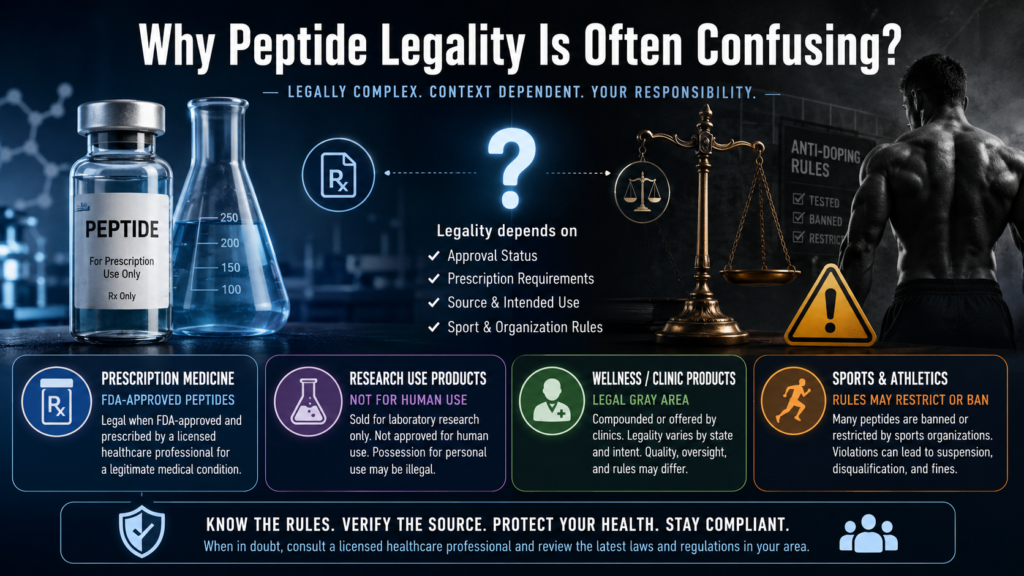
Peptide legality is confusing because the same word can refer to very different products. A prescription medicine is not the same as a research chemical. A cosmetic peptide is not the same as an injectable compound marketed for recovery. A regulated pharmacy product is not the same as an online product with unclear sourcing.
This confusion is similar to broader issues in the performance-enhancement market, where labels, supplier claims, and actual product contents may not always match. Understanding counterfeit steroids risk and safety concerns is relevant here because unregulated products can create problems around authenticity, quality, contamination, and legal exposure.
Health and Safety Concerns
The biggest concern with unapproved peptides is uncertainty. A person may not know whether the product contains the claimed ingredient, whether the concentration is accurate, whether contaminants are present, or whether the compound has been adequately studied in humans.
Some peptides may also affect hormone signaling, blood sugar regulation, appetite, immune response, tissue growth, or other biological systems. These effects can be medically significant. A product may be marketed as targeted or mild, but that does not mean it is free from risk.
Quality Control and Product Authenticity
Products obtained outside regulated medical and pharmacy channels may have uncertain manufacturing standards. The label may not accurately reflect the contents. Storage conditions may be unclear. Batch consistency may not be reliable.
This is especially important for products marketed toward bodybuilding, recovery, weight loss, or anti-aging, where consumer demand may encourage sellers to make claims that are not fully supported by approval status or clinical evidence.
Medical Supervision Matters
Peptides that affect metabolism, hormones, appetite, or tissue signaling should not be treated as casual wellness products. Even legitimate medicines can carry risks, side effects, contraindications, and monitoring requirements.
A medically cautious approach means not making decisions based on online marketing, gym discussions, or social media testimonials. Legal and medical guidance should come from licensed professionals and official regulatory sources.
Why Athletes Should Be Extra Careful?
Athletes should be especially cautious because anti-doping rules can apply even when a product is obtained from a clinic, supplement provider, or online source. A product does not need to be called a steroid to create an anti-doping issue.
Some peptide-related substances are promoted for recovery or injury support, but that does not mean they are allowed in sport. WADA’s prohibited categories include peptide hormones, growth factors, related substances, and mimetics, which makes verification essential for tested athletes.
Athletes are usually responsible for what enters their body. That means the risk is not only whether a product is effective or safe. The risk also includes eligibility, sanctions, reputation, and career consequences.
Why Medical and Legal Guidance Matters?
Peptide legality and safety cannot be judged from marketing claims, product labels, or online discussions alone. A compound may be prescription-only, unapproved for human use, restricted in a certain country, or prohibited under sport rules. Product quality may also vary when a peptide is obtained outside regulated medical and pharmacy channels.
Anyone researching peptides should rely on licensed medical professionals and official regulatory sources rather than seller claims, wellness marketing, or informal bodybuilding discussions.
Practical Takeaway
Peptides intended effects depend on the specific compound being discussed. Some peptide-based medicines have legitimate medical uses, while other peptide products are marketed for recovery, fat loss, anti-aging, performance, or body composition without the same level of approval, safety evidence, or quality control.
Peptides are not automatically legal or safe just because they are peptides. Their status depends on the substance, country, prescription requirements, approval status, source, and sports rules. Products sold online as research-use chemicals or wellness peptides may carry quality, safety, medical, and legal concerns.
From an educational and risk-awareness perspective, peptides should not be treated as one simple category. Some are legitimate medicines, some are unapproved or restricted products, and some are prohibited in sport. The safest approach is to rely on licensed medical guidance and verified legal sources rather than online marketing claims.