
Cold showers after workouts are often promoted as a simple way to reduce soreness, feel refreshed, and speed up muscle recovery. They may help some people feel less inflamed or more comfortable after training, but they are not a magic recovery method. For muscle growth, the timing and purpose matter because some inflammation after resistance training is part of the normal adaptation process.
The short answer is that cold showers may help with temporary soreness and perceived recovery, but they do not replace sleep, nutrition, hydration, smart training volume, and proper rest. For bodybuilders and strength athletes, the bigger question is not only whether cold showers feel good after training, but whether they support or interfere with the adaptation you are trying to create.
Why Cold Showers Became Popular After Training?
Cold exposure has been used in sports for years, especially after intense competitions, endurance events, or physically demanding training blocks. Athletes often use ice baths, cold-water immersion, or contrast showers to manage soreness and reduce the feeling of fatigue.
Cold showers are the simpler version. They are easier to access, require no special equipment, and can provide a quick cooling effect after a sweaty workout. This is why many lifters use them after hard gym sessions, especially when they feel overheated, sore, or physically drained.
The appeal is understandable. A cold shower can make the body feel lighter, reduce heat discomfort, and create a short-term sense of alertness. But feeling refreshed is not always the same as improving muscle recovery at the tissue level.
What Happens to the Body After a Workout?
After resistance training, the body goes through several recovery and adaptation processes. Muscle fibers experience mechanical tension and microscopic disruption. The nervous system responds to the stress of lifting. Energy stores need to be replenished. Fluids and electrolytes may need to be restored. The body also begins repair processes that contribute to strength and muscle development over time.
Some soreness after training, especially after a new exercise or higher volume, is normal. This does not mean the workout was automatically better, but it does show that the body experienced a stimulus it needs to recover from.
This is why recovery should be viewed as a complete system. As discussed in steroid recovery capacity, training recovery involves more than whether a muscle feels sore or fresh the next day. It includes tissue repair, nervous system readiness, sleep quality, nutrition, and how well the body handles repeated training stress.
How Cold Showers May Help After Workouts?
Cold showers may provide some short-term benefits, especially when the goal is comfort rather than maximizing muscle growth signaling.
They May Reduce the Feeling of Soreness
Cold water can reduce the sensation of soreness by lowering skin temperature and creating a numbing effect. This may make the body feel less achy after hard training.
However, reduced soreness does not always mean faster muscle repair. It may simply mean the soreness feels less noticeable. This distinction is important because muscle recovery is not only about comfort.
They Can Help Cool the Body Down
After intense training, especially in hot weather or poorly ventilated gyms, a cold shower can help lower body heat and make the person feel more comfortable. This can be useful after high-sweat sessions, conditioning work, or long workouts.
Cooling down can also help some people feel more relaxed after exercise, although others may find cold water too stimulating.
They May Improve Perceived Recovery
Perceived recovery matters because it can affect motivation and readiness for the next workout. If a cold shower helps someone feel cleaner, calmer, and less physically drained, that can have a practical benefit.
Still, perceived recovery should not be confused with full recovery. A person may feel fresh but still need time for muscle tissue, joints, and the nervous system to recover.
Why Cold Showers May Not Be Ideal Immediately After Muscle-Building Workouts?
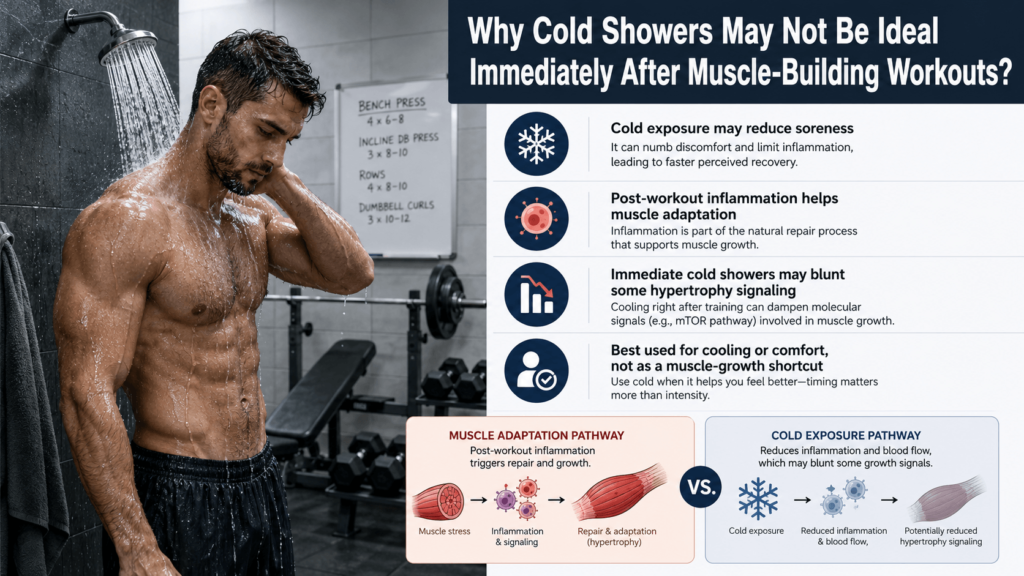
The main concern with cold exposure after lifting is that it may reduce some of the natural inflammatory and cellular signaling processes involved in muscle adaptation. Inflammation is often viewed negatively, but not all inflammation is bad. After resistance training, a controlled inflammatory response helps start the repair and remodeling process.
For bodybuilding, this matters because the goal is not only to feel less sore. The goal is to create a training stimulus that leads to adaptation. If cold exposure is used too aggressively right after lifting, especially in the form of very cold water or long exposure, it may not be the best choice when hypertrophy is the priority.
Cold showers are usually milder than ice baths, so the effect may be smaller. But the principle is still worth understanding: reducing soreness immediately after training is not always the same as improving muscle growth.
Cold Showers vs. Ice Baths
Cold showers and ice baths are often discussed together, but they are not identical. Ice baths expose the body to colder temperatures for a more sustained period. Cold showers are usually shorter, less intense, and easier to control.
| Recovery Method | Typical Effect | Best Use Case | Possible Limitation |
| Cold shower | Mild cooling and refreshed feeling | General comfort after training | May not produce deep recovery changes |
| Ice bath | Stronger cold exposure | Soreness management after intense events | May blunt some adaptation signals if used right after lifting |
| Contrast shower | Alternates warm and cold water | Relaxation and circulation-focused routines | Effects can vary by person |
| Warm shower | Relaxation and muscle comfort | Evening recovery and stress reduction | Less useful for rapid cooling |
| Normal shower | Cleanliness and comfort | Everyday post-workout routine | No special recovery effect |
For most gym-goers, a cold shower is less extreme than an ice bath. It may help with comfort and alertness without being as disruptive as prolonged cold-water immersion. Still, if the goal is maximum muscle growth, it may be smarter not to treat cold exposure as a required post-lifting habit.
When Cold Showers May Be Useful?
Cold showers after workouts may be useful in certain situations. They can be helpful after very hot training sessions, outdoor workouts, conditioning, or sports practice where overheating and discomfort are bigger concerns than muscle growth signaling.
They may also be useful when soreness is interfering with daily comfort. For example, someone who feels very stiff after a hard session may use a short cold shower to feel more mobile and refreshed.
Better Fit for Performance Recovery Than Hypertrophy
Cold exposure may make more sense when the goal is to recover quickly for another performance event, practice, or physically demanding day. In those situations, reducing soreness and perceived fatigue may be more important than maximizing the muscle-building response from one workout.
For hypertrophy-focused training, the decision is more nuanced. If the workout was designed to stimulate muscle growth, especially through resistance training, immediately trying to suppress the body’s normal response may not always be ideal.
When Cold Showers May Be Less Useful?
Cold showers may be less useful if someone relies on them while ignoring the bigger recovery factors. Poor sleep, inconsistent protein intake, excessive training volume, and dehydration cannot be fixed by standing under cold water for a few minutes.
They may also be less useful right after strength or bodybuilding sessions where the main goal is muscle adaptation. In that case, a normal shower or slightly cool rinse may be enough for comfort without turning cold exposure into a major recovery intervention.
This is similar to how training frequency on steroids should not be judged only by whether someone feels ready to train again. Feeling fresh is helpful, but actual recovery depends on deeper biological and lifestyle factors.
Do Cold Showers Help With Muscle Soreness?
Cold showers may help reduce the feeling of soreness for some people, especially in the short term. But soreness is not the same as muscle damage, and less soreness does not always mean better recovery.
For example, a lifter may feel less sore after a cold shower but still need rest before training the same muscle group again. Another lifter may skip cold showers, feel mild soreness, and still recover well because sleep, food intake, and training volume are properly managed.
This is important because soreness can be misleading. As discussed in chest sore after bench press, feeling soreness in a muscle does not always prove that the workout was better, and not feeling soreness does not mean the muscle was not trained.
The Bigger Recovery Priorities
Cold showers can be part of a recovery routine, but they should not be treated as the foundation. The most reliable recovery factors are still the basics.
Sleep Quality
Sleep is one of the strongest recovery tools because it supports tissue repair, nervous system recovery, hormonal regulation, and mental readiness. Poor sleep can reduce training quality even if other recovery methods are used.
Nutrition
Muscle recovery depends on enough total calories, protein, carbohydrates, fats, vitamins, minerals, and hydration. A cold shower cannot compensate for poor nutrition.
Training Management
Excessive volume, too many hard sets, poor technique, and inadequate rest days can create recovery problems. If the training plan is poorly managed, cold showers may only mask discomfort without solving the real issue.
Stress Control
Daily stress affects recovery. A person who trains hard, sleeps poorly, and lives under constant stress may struggle to recover even with good post-workout habits.
Practical Way to Use Cold Showers After Workouts
For most people, cold showers are best viewed as optional. They can help with comfort, heat management, and perceived soreness, but they should not be treated as essential for muscle growth.
If the workout is mainly for conditioning, sport performance, or general fitness, a cold shower may be fine after training. If the workout is mainly for hypertrophy, it may be better to avoid very cold, prolonged exposure immediately after lifting. A normal shower, lukewarm shower, or short cool rinse may be enough.
The key is to match the recovery method to the goal. If the goal is to feel refreshed after a hot session, cold water can help. If the goal is to maximize muscle-building adaptation, the basics matter more than chasing reduced soreness.
Practical Takeaway
Cold showers after workouts can help some people feel refreshed, cooler, and less sore, but they are not a guaranteed way to speed up true muscle recovery. They may reduce discomfort, but reduced soreness does not always mean faster repair or better muscle growth.
For bodybuilding and strength training, cold exposure immediately after lifting should be used thoughtfully. Some inflammation after training is part of the adaptation process, and trying to suppress it too aggressively may not always support hypertrophy goals.
The best recovery plan is still built around sleep, nutrition, hydration, manageable training volume, and consistent rest. Cold showers can be a useful comfort tool, but they should stay secondary to the habits that actually drive long-term recovery and performance.